
Managing a class and managing an academy may sound similar at first. Both involve students, teachers, schedules, and learning.
But the responsibilities change when the focus moves from one class to an entire academy.
A class usually revolves around one group of students and a specific learning goal. An academy has to coordinate multiple groups, people, courses, and activities at the same time.
A Class Has One Main Focus
When a teacher manages a class, the main focus is the students and their learning.
This may involve preparing lessons, explaining topics, answering questions, checking assignments, and helping students stay on track.
Most decisions are closely connected to that particular group, which makes it easier to respond to issues as they come up.
An Academy Has a Wider Scope
Academy management goes beyond what happens inside one classroom.
There may be several courses, batches, tutors, and student groups running at the same time. Each may have different schedules, requirements, and priorities.
The challenge is not only to manage each group properly but also to make sure they fit together without creating conflicts.
For example, changing one class schedule may affect a tutor, another batch, or several students. A new course may also require changes in planning and responsibilities.
One Group vs. Multiple Groups
A teacher usually works closely with one group and understands its specific needs.
An academy may have many groups at different stages.
One batch could be starting a course while another is preparing for an exam. A third group may have a different tutor or timetable.
This requires academy teams to consider individual groups while also keeping track of what is happening across the organization.
Individual Decisions vs. Coordinated Decisions
In a classroom, many decisions can be handled directly by the teacher.
Academy management often involves several people.
If a class needs to move to a different time, for example, the tutor, students, and administrative team may all need to know about the change.
The decision itself may be simple. Coordinating everyone around that decision is what makes academy management more involved.
Today’s Class vs. What Comes Next
Class management often focuses on immediate needs — the lesson, students, assignments, or activities happening that day.
Academy management also requires ongoing planning.
New batches may be starting soon. Course schedules may need to be adjusted. Tutor responsibilities may change. Student numbers may increase or decrease.
So academy teams have to think about both current activities and what needs to happen next.
One View vs. Many Perspectives
A teacher mainly looks at the academy through the classroom experience.
An academy needs to consider several perspectives at once.
Students need a smooth learning experience. Tutors need clear information about their responsibilities. Administrative teams need to coordinate daily activities. Management needs visibility across the academy.
Keeping these perspectives connected becomes increasingly important as the academy grows.
Class-Level Success vs. Academy-Wide Consistency
A method that works well for one teacher may not always work when several tutors and teams are involved.
Growing academies need some consistency in how important activities are handled.
That does not mean every class has to operate in exactly the same way. It means teams need clear processes so that information and responsibilities do not depend entirely on individual habits.
The Difference Is More Than Size
An academy is not simply a bigger version of a classroom.
The real difference is the scope of responsibility.
A class focuses mainly on helping one group of students learn effectively. An academy has to create an environment where multiple classes, tutors, students, and activities can work together.
As that scope increases, coordination becomes just as important as individual classroom management.
Managing an Academy as a Whole
When an academy grows, managing everything through separate processes can make coordination harder.
Teams need a clear view of their responsibilities and access to the information they need to make decisions.
This is where a structured academy management system can help.
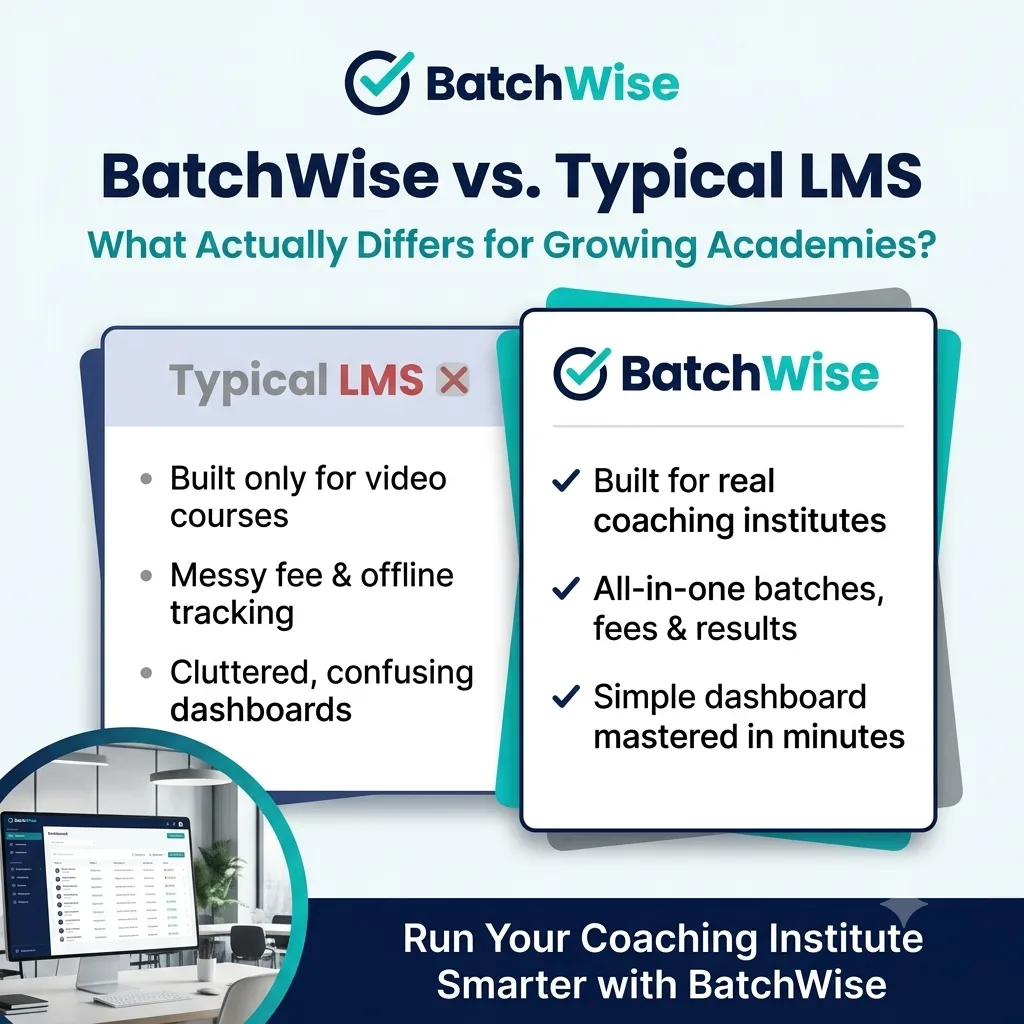
Batchwise brings key academy activities into one platform, including students, tutors, batches, fees, attendance, assignments, exams, certificates, recordings, timetables, and reports.
The goal is not to replace classroom management. It is to support the wider work happening around every class.
From Managing One Class to Managing the Whole Academy
Managing a class is mainly about one group, one learning environment, and its immediate needs.
Managing an academy means coordinating everything around multiple classes and keeping the overall operation organized.
The difference is not simply the number of students or classes. It is the wider responsibility that comes with managing them together.
With the right structure and tools in place, academy teams can spend less time coordinating disconnected activities and more time supporting effective learning.
See how Batchwise can help you manage your academy beyond the classroom.
Explore Batchwise → https://gobatchwise.com/